
Joke Structures

I’d like to share with you guys some of my favorite joke structures in comic strips. I find that when you really break things down, many cartoons and comics function on a few basic formulas. If you can figure out the formulas, then you can build on them as foundations for coming up with your own jokes and stories. In the comics class I teach, my students recently made a series of comics based on some of these joke formulas. I’ve picked out a few of my favorite formulas and also picked out a few Peanuts strips from the 1950s to illustrate them.
I’ve been getting into Peanuts lately. I got some of the Fantagraphics books that collect all of the strips, and I started listening to this podcast, Unpacking Peanuts, where they go through the strips year by year and really dig into the mechanics and history of it. I love listening to the podcast as I read the strips because it gives me some outside perspectives on what I’m reading, some historical context, and a much deeper appreciation of the comic.
Build Up Let Down
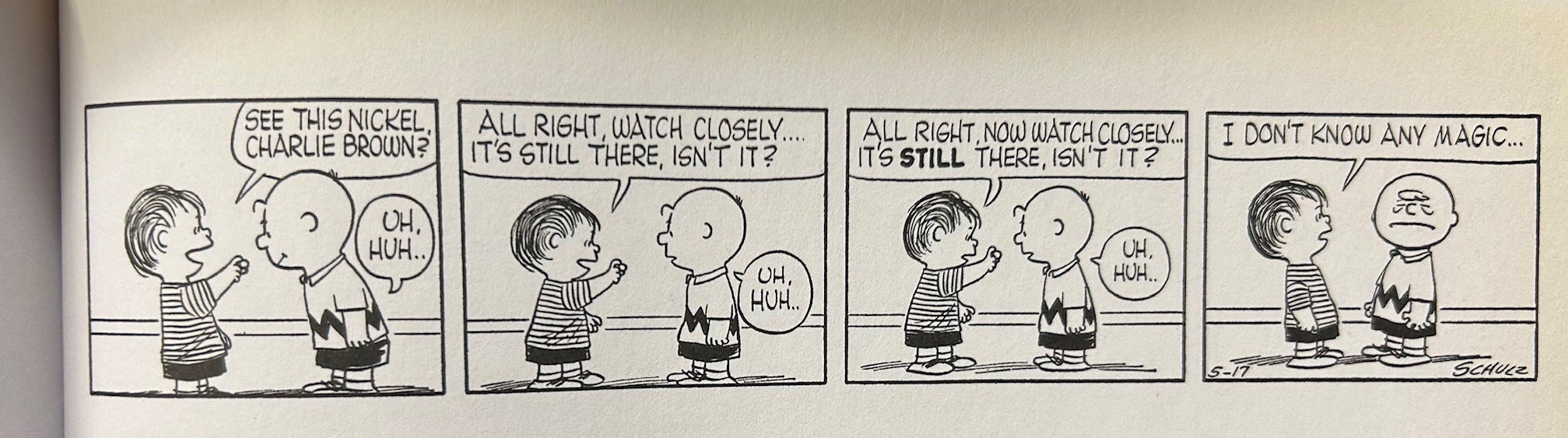
The joke structure I think is probably the most common is what I call “build up let down.” As with any joke, the basic structure is a set up and then a punchline. In Peanuts strips you have four panels, so, in this example, the first three panels are the set up, and the fourth panel is the punch line. In the first three panels we’re building up. We feel as if we are building closer and closer to Linus doing a magic trick. But then in the last panel we are let down, or at least the characters are. Despite Linus’s buildup, he doesn’t actually know any magic. We expect one thing to happen, a magic trick, and then when something different happens that we didn’t see coming, that’s where the humor comes from.
